How to Win in Race Survival: Arena King

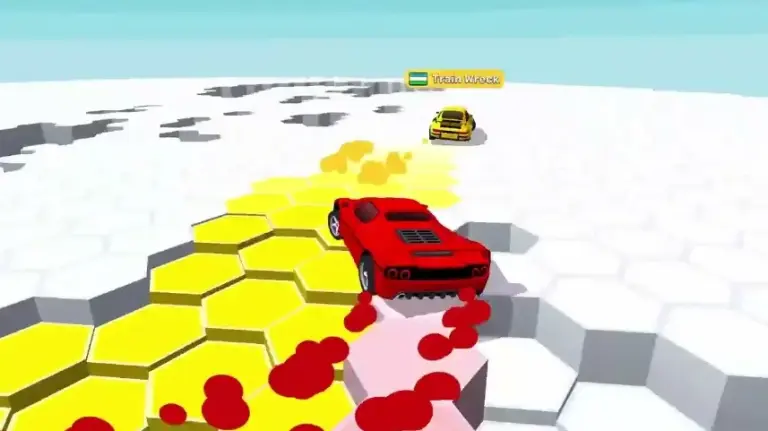
Winning a match in Race Survival: Arena King requires more than aggressive driving. Every movement removes potential driving space, making environmental awareness as important as vehicle control.
Players who constantly chase opponents may eliminate themselves before achieving a useful result. Those who avoid all confrontations can also become trapped when the remaining platforms disappear. An effective strategy combines defensive positioning, selective attacks, controlled jumping, and anticipation of how the arena will develop.
Early Game Strategy: Preserve Driving Space
The opening stage provides the largest amount of connected ground. This is an opportunity to establish a favorable position before other vehicles divide the arena into separate sections.
Avoid driving repeatedly across the same neighborhood of hexagons. Tight circles can surround the vehicle with its own disappearing trail.
Instead, use wider turns and examine where other cars are heading. Try to remain in an area that offers multiple directions for future movement.
Your priorities during the opening stage should be:
- Identify relatively empty sections of the arena.
- Avoid unnecessary collisions.
- Maintain access to several connected routes.
- Observe which areas opponents are destroying.
- Collect accessible rewards without making major detours.
- Reserve risky jumps for situations that require them.
Preserving space does not mean remaining stationary because the vehicle continues moving automatically. It means selecting routes that leave alternative directions available.
Middle Game Strategy: Manage the Shrinking Arena
After several vehicles have crossed the platform, gaps begin separating intact sections. Movement decisions become more important because errors are increasingly difficult to correct.
| Battlefield situation | Recommended strategy |
|---|---|
| Opponents gathered in one area | Move toward a less occupied section |
| Previously traveled route | Assume some tiles may soon disappear |
| Large central gap | Locate a connected route around it or prepare a jump |
| Narrow passage | Establish the correct heading before entering |
| Several isolated platforms | Select the group with the best exit |
| Opponent approaching an edge | Consider a controlled attack |
During this stage, avoid treating every visible platform as equally valuable. A larger area with several possible exits is generally more useful than a narrow strip containing a collectible.
How to Knock Opponents Off the Arena
Vehicle contact is one of the methods available for eliminating competitors. Successful attacks depend on the angle of approach and surrounding platform conditions.
A rival positioned near a gap or boundary has fewer opportunities to recover from a collision. However, the attacking vehicle is also affected by the impact.
When preparing an attack:
- Identify the opponent’s current direction.
- Check the condition of the surrounding tiles.
- Choose an approach that directs the rival toward a dangerous area.
- Maintain access to intact ground on your own side.
- Make contact without committing to a prolonged pursuit.
- Redirect your vehicle toward a safe route afterward.
Side impacts may be useful when an opponent is traveling close to an edge. Head-on collisions are less predictable and can place both vehicles in danger.
The purpose of an attack is to reduce the opponent’s recovery options without sacrificing your own.
Offensive vs. Defensive Driving
Players can alternate between aggressive and defensive strategies depending on the condition of the battlefield.
| Strategy | Advantages | Disadvantages |
|---|---|---|
| Aggressive driving | Creates opportunities for eliminations and crowns | Increases collision and positioning risks |
| Defensive driving | Reduces unnecessary confrontations | May allow rivals to control useful areas |
| Collectible-focused driving | Supports vehicle progression | Can distract from survival |
| Balanced driving | Allows adaptation to changing conditions | Requires continuous assessment |
A balanced approach is generally suitable for players developing their skills. It allows them to avoid unnecessary combat while taking advantage of favorable opportunities.
Players interested in vehicle combat can also explore Smash Karts, which provides a different approach to driving and attacking opponents.
How to Survive the Final Stage of a Battle
When only a few vehicles remain, the arena usually contains fewer connected driving surfaces. Large gaps restrict movement, and even a small steering error can end the match.
During the final stage:
- Stop prioritizing difficult collectibles.
- Avoid chasing opponents across unstable routes.
- Aim for the largest reachable platform groups.
- Check landing areas before performing jumps.
- Use available ramps when their destinations are suitable.
- Avoid collisions that could eliminate both vehicles.
- Allow opponents to make risky decisions when you have a safe route.
A final opponent does not necessarily need to be eliminated through direct contact. Continuing to survive while the rival loses access to solid ground can produce the same victory.
How to Improve Jumping and Landing
Aerial movement becomes increasingly important as the arena breaks apart.
Use Practice mode to understand how far your vehicle can travel during a normal jump. In versions containing wings or extended aerial movement, learn how the second input changes the trajectory.
The following table provides a suggested training routine:
| Training exercise | Purpose |
|---|---|
| Jump across a small gap | Learn basic takeoff timing |
| Jump from different approach angles | Understand directional alignment |
| Use a ramp | Study extended aerial movement |
| Land on a wide platform | Improve landing consistency |
| Turn after landing | Prepare for consecutive obstacles |
| Cross several gaps | Develop route planning |
Successful landings should leave enough room for the next maneuver. Reaching a single isolated tile without an exit rarely provides a lasting advantage.
Why Players Keep Losing Matches
Repeated elimination often indicates a specific movement habit rather than a general lack of skill.
For example, frequently falling after passing an opponent suggests excessive commitment to attacks. Losing inside empty areas may indicate poorly controlled turns. Falling after jumps usually means that the destination was not evaluated sufficiently.
Review the circumstances of each elimination and identify whether it resulted from steering, jumping, collision positioning, or route selection.
Winning consistently in Race Survival: Arena King depends on reducing avoidable errors. Aggressive driving can produce additional rewards, but controlling the remaining battlefield is often more valuable than pursuing every available opponent.